Plant Lighting Systems

Plant lighting starts with the light received by leaves over their occupied area and schedule. A fixture’s electrical rating, photon output and distribution answer different questions. Choose a fixture and mounting plan together, using evidence collected at the relevant distance and power setting.

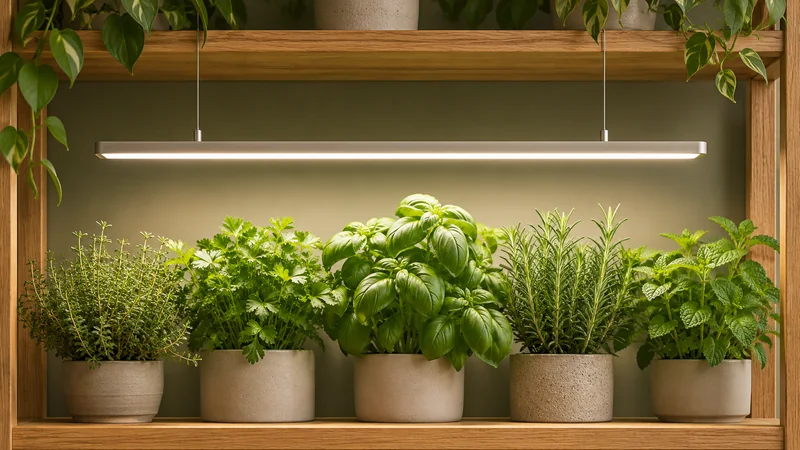
A linear grow light above a shelf of herbs
Illustrative equipment scene

· GROWVELIA Editorial Researcher

Understanding indoor plant lighting

Write a lighting brief for a crop, growth stage and receiving surface. Decide how much of the tray must be usable, how far the fixture can sit above the canopy and when it can operate. A seedling rack, a deep shelf and a corner houseplant have different geometry even if their lamps use the same power. Useful light arriving at the plants depends on optics, fixture position, the canopy and nearby surfaces.

Measurements from fixture to crop
  1. Electrical input in watts
  2. Fixture photon output
  3. Canopy-level PPFD grid

Fixture types and where each fits

Fixture typeTypical fitWhat to verify
Linear LED barsShallow shelves and long rowsBar spacing, end and edge readings, mounting clearance.
LED board or panelA continuous canopy under one fixtureGrid geometry, edge intensity, dimming setting and heat clearance.
Directional bulbOne pot or a small group at a defined distanceSocket and fitting limits, beam shape and intensity away from the beam centre.
Fluorescent tubesAn existing seed-starting shelf with a compatible fixtureTube and ballast compatibility, lamp condition and usable light at canopy level.

The shape of the lit surface is a useful starting point for choosing a fixture. On a long rack shelf, several parallel bars can put light near both edges. The gaps between them still need measurement, especially if the fixture must sit close to the plants. A panel concentrates the hardware in one assembly and can suit a squarer canopy. Use a map taken at the intended mounting height to check coverage in the corners where plants will actually sit.

The retrofit decision depends on the existing fixture as well as the lamp. Check the maker’s instructions before replacing a fluorescent tube with an LED tube. For any fixture type, compare the area that meets your light requirement at the planned height and power setting.

PPF, PPFD, PPE and daily light integral

MetricMeaningDecision it supports
PPF (µmol/s)Photosynthetic photon flux emitted by the fixture, conventionally counted from 400 to 700 nm.Compare source output on the same spectral basis.
PPFD (µmol/m²/s)Photon flux per unit area incident at a stated location and plane.Check what leaves receive at the planned mounting height.
PPE (µmol/J)Photosynthetic photon efficacy, calculated as PPF divided by electrical input in watts.Compare photon output per unit of input energy under equivalent test conditions.
DLI (mol/m²/day)Daily light integral, the accumulated photons per unit area over the day.Evaluate a schedule or combine time-varying daylight and electric light.

A high PPF fixture may distribute its output widely or deliver much of it outside a small tray. A high PPE fixture can still use more electricity if it is a larger unit or runs longer. Watts measure electrical input and do not establish a PPFD value. When the light is constant, DLI equals PPFD multiplied by hours and 0.0036. When contribution varies, integrate over time or sum the separate intervals at the same receiving location. An average across a tray can hide an underlit edge. A point-specific DLI can expose that condition.

Spectrum and coverage

A spectral distribution describes how output is spread across wavelengths. A label such as full spectrum, a color appearance or a color temperature does not describe that distribution completely. Look for a spectral chart and identify how the range was integrated. Conventional photosynthetic metrics use 400–700 nm. If a source includes longer wavelengths under a different metric, keep those totals on their own basis. Spectrum can affect plant development, but an emitter description alone cannot establish the resulting canopy exposure or a crop response.

Coverage is meaningful with an area, mounting distance, output setting and an explicit criterion. Two manufacturers can report different coverage footprints for similar output because their criteria differ. Read a rectangular map in both directions. The long axis of a bar may be well served while the front rim of a shelf receives less light. For a panel, note whether measurements were taken inside reflective walls or in an open room.

Mounting height, distribution and uniformity

Compare maps with the same dimensions, sample grid, canopy plane and mounting height. Record the minimum, mean and peak over the occupied region. Minimum to mean is one useful uniformity ratio when the same grid and area are used. For a few specific plants, mark their sites directly and compare their readings. An unweighted average from irregularly spaced samples can overrepresent a densely measured center. Use comparable sampling or area weighting where appropriate.

Raising a fixture can smooth a hotspot and improve coverage near the edge. It can also reduce the mean and spill more light beyond the tray. Lowering it may concentrate output at the center. Simple point-source falloff rules are unreliable for broad fixtures at close distances. Recheck after a change in canopy height, spacing or fixture tilt. For multiple fixtures, assess the combined field in the proposed installation, including where beams overlap.

Dimming, thermal management and electrical input

Review the usable dimming range, driver type, control interface and restart behavior. A dial may change output without changing input power in exact proportion. Measure input at the intended setting if the energy budget depends on it. Identify whether reported watts include the driver or an entire group of linked bars. Include standby only for the hours spent in that state.

The heat sink and driver need their specified clearance. A fixture can still move useful photons toward the plants while adding heat to the room, and a driver inside a cabinet adds to the enclosure’s heat burden. A remote driver can change where heat is released only if the fixture supports that installation. Assess the temperature at the intended location and operating schedule.

Manufacturer and independent measurements

A manufacturer declaration can identify a model and provide a useful first map. Record the revision, power setting, distance, grid, room and any available instrumentation. An independent measurement is an observation under its own conditions. A documented outside test has comparison value when those conditions are known. A laboratory fixture-output measurement also answers a different question from a tray-level map. If two maps disagree and the setups differ, keep the results with their respective geometry instead of averaging them. The model comparisons below identify cases where the name, emitter label or input power gives an incomplete installation brief.

Practical lighting scenarios

Starts at the edge of a narrow shelf

Illustrative Scenario

A 90 × 30 cm shelf has a hypothetical 190 µmol/m²/s center and 95 at the occupied front edge for 14 hours. Those sites receive about 9.58 and 4.79 mol/m²/day. If the edge misses the crop brief, reposition the tray or evaluate a second bar and remap. The example describes two points, not the shelf's mean.

An evening schedule beside a window

Illustrative Scenario

Assume a canopy location receives 4.0 mol/m² during daylight and the fixture can run for five additional hours. A hypothetical target of 9.0 mol/m²/day leaves 5.0 to supply, which implies roughly 278 µmol/m²/s for those hours. Measure both contributions at the same location. A seasonal daylight drop would invalidate the fixed estimate unless the schedule or output can change.

A dimmed panel in an enclosure

Illustrative Scenario

A fixture hypothetically draws 62 W at one selected setting and runs 12 hours, using about 0.744 kWh per day before auxiliary loads. The resulting energy figure says nothing about light at the lowest shelf. Record canopy PPFD, ventilation behavior and wall input at the same setting before deciding whether dimming meets both briefs.

Daily light at two shelf positions · hypothetical 14-hour schedule
Shelf center9.58 mol/m²/day
Occupied front edge4.79 mol/m²/day

Common specification misunderstandings

A larger wattage, a center-only PPFD figure or a coverage claim without measurement conditions can each send a shortlist in the wrong direction. Ask for a map and compare the occupied region at feasible heights. A dimming percentage is a setting label until the relationship to light and input power is established.

Related products

Models listed here belong to this category in the GROWVELIA product database. Open a model for its full specifications, evidence and revision history.

36 product records

Barrina OG11A clip-on configuration

Version unknown · LED plant lighting

Current per recorded source3/9 applicable record fields documented
Rated fixture power
11 W
Photosynthetic photon flux
Not Provided
PPFD with measurement conditions
Not Provided
Photon efficacy
Not Provided
Coverage with stated conditions
Not Provided
Dimming
Dimmable

Barrina OG11D

Version unknown · LED plant lighting

Current per recorded source4/10 applicable record fields documented
Rated fixture power
11 W
Photosynthetic photon flux
Not Provided
PPFD with measurement conditions
Not Provided
Photon efficacy
Not Provided
Coverage with stated conditions
Not Provided
Dimming
Dimmable

Barrina OG25A

Version unknown · LED plant lighting

Current per recorded source4/10 applicable record fields documented
Rated fixture power
25 W
Photosynthetic photon flux
Not Provided
PPFD with measurement conditions
Not Provided
Photon efficacy
Not Provided
Coverage with stated conditions
Not Provided
Dimming
Dimmable

Barrina T1X3

Version unknown · LED plant lighting

Unknown3/10 applicable record fields documented
Rated fixture power
30 W
Photosynthetic photon flux
Not Provided
PPFD with measurement conditions
Not Provided
Photon efficacy
Not Provided
Coverage with stated conditions
Not Provided
Dimming
Not Provided

Barrina T1X5

Version unknown · LED plant lighting

Current per recorded source4/11 applicable record fields documented
Rated fixture power
50 W
Photosynthetic photon flux
Not Provided
PPFD with measurement conditions
Not Provided
Photon efficacy
Not Provided
Coverage with stated conditions
Not Provided
Dimming
Not Provided

Barrina TR40A adjustable

Version unknown · LED plant lighting

Current per recorded source4/10 applicable record fields documented
Rated fixture power
40 W
Photosynthetic photon flux
Not Provided
PPFD with measurement conditions
Not Provided
Photon efficacy
Not Provided
Coverage with stated conditions
Not Provided
Dimming
Not Provided

Barrina TR40D

Version unknown · LED plant lighting

Current per recorded source3/10 applicable record fields documented
Rated fixture power
40 W
Photosynthetic photon flux
Not Provided
PPFD with measurement conditions
Not Provided
Photon efficacy
Not Provided
Coverage with stated conditions
Not Provided
Dimming
Not Provided

Barrina TX-S50

Version unknown · LED plant lighting

Current per recorded source4/11 applicable record fields documented
Rated fixture power
50 W
Photosynthetic photon flux
Not Provided
PPFD with measurement conditions
Not Provided
Photon efficacy
Not Provided
Coverage with stated conditions
Not Provided
Dimming
Not Provided

Mars Hydro TS-600

MARS-TS-02 202211 documented revision · panel led

Unknown5/10 applicable record fields documented
Rated fixture power
100 W
Photosynthetic photon flux
Not Provided
PPFD with measurement conditions
Not Provided
Photon efficacy
Not Provided
Coverage with stated conditions
2 × 2 ft
Dimming
Not dimmable

Mars Hydro TS-1000

MARS-TS-02 202211 documented revision · panel led

Unknown5/10 applicable record fields documented
Rated fixture power
150 W
Photosynthetic photon flux
Not Provided
PPFD with measurement conditions
Not Provided
Photon efficacy
Not Provided
Coverage with stated conditions
2.5 × 2.5 ft
Dimming
10–100%

Mars Hydro TS-3000

MARS-TS-02 202211 documented revision · panel led

Unknown5/10 applicable record fields documented
Rated fixture power
450 W
Photosynthetic photon flux
Not Provided
PPFD with measurement conditions
Not Provided
Photon efficacy
Not Provided
Coverage with stated conditions
5 × 5 ft
Dimming
10–100%

Mars Hydro TSL-2000

MARS-TS-02 202211 documented revision · panel led

Unknown5/10 applicable record fields documented
Rated fixture power
300 W
Photosynthetic photon flux
Not Provided
PPFD with measurement conditions
Not Provided
Photon efficacy
Not Provided
Coverage with stated conditions
3 × 5 ft
Dimming
10–100%

Mars Hydro TSW-2000

MARS-TS-02 202211 documented revision · panel led

Unknown5/10 applicable record fields documented
Rated fixture power
300 W
Photosynthetic photon flux
Not Provided
PPFD with measurement conditions
Not Provided
Photon efficacy
Not Provided
Coverage with stated conditions
4 × 4 ft
Dimming
10–100%

SANSI A21 15W

C21GL-DE26-15W documented · LED plant lighting

Unknown5/10 applicable record fields documentedConflicting Data
Rated fixture power
15 W
Photosynthetic photon flux
27.2 µmol/s
PPFD with measurement conditions
130.06 µmol/m²/s
Photon efficacy
Not Provided
Coverage with stated conditions
Not Provided
Dimming
Not Provided

SANSI BR30 24W

Version unknown · LED plant lighting

Current per recorded source5/9 applicable record fields documented
Rated fixture power
24 W
Photosynthetic photon flux
36.2 µmol/s
PPFD with measurement conditions
177.06 µmol/m²/s
Photon efficacy
Not Provided
Coverage with stated conditions
Not Provided
Dimming
Not Provided

SANSI BR30 36W

Version unknown · LED plant lighting

Current per recorded source4/10 applicable record fields documented
Rated fixture power
36 W
Photosynthetic photon flux
65.6 µmol/s
PPFD with measurement conditions
Not Provided
Photon efficacy
Not Provided
Coverage with stated conditions
Not Provided
Dimming
Not Provided

SANSI PAR20 10W

Version unknown · LED plant lighting

Current per recorded source4/10 applicable record fields documented
Rated fixture power
10 W
Photosynthetic photon flux
16.8 µmol/s
PPFD with measurement conditions
Not Provided
Photon efficacy
Not Provided
Coverage with stated conditions
Not Provided
Dimming
Not Provided

Soltech Aspect Gen 2

2 · residential display led

Current per recorded source4/10 applicable record fields documented
Rated fixture power
36 W
Photosynthetic photon flux
50 µmol/s
PPFD with measurement conditions
Not Provided
Photon efficacy
Not Provided
Coverage with stated conditions
Not Provided
Dimming
Not Provided

Soltech Aura

Version unknown · residential display led

Unknown4/10 applicable record fields documented
Rated fixture power
11.4 W
Photosynthetic photon flux
20.34 µmol/s
PPFD with measurement conditions
Not Provided
Photon efficacy
Not Provided
Coverage with stated conditions
Not Provided
Dimming
Not Provided

Soltech Grove

Version unknown · residential display led

Current per recorded source4/10 applicable record fields documented
Rated fixture power
11 W
Photosynthetic photon flux
17 µmol/s
PPFD with measurement conditions
Not Provided
Photon efficacy
Not Provided
Coverage with stated conditions
Not Provided
Dimming
Not Provided

Soltech Highland

Version unknown · residential display led

Unknown4/10 applicable record fields documented
Rated fixture power
30 W
Photosynthetic photon flux
40 µmol/s
PPFD with measurement conditions
Not Provided
Photon efficacy
Not Provided
Coverage with stated conditions
Not Provided
Dimming
Not Provided

Soltech Vita

Version unknown · residential display led

Unknown4/10 applicable record fields documented
Rated fixture power
20 W
Photosynthetic photon flux
25.95 µmol/s
PPFD with measurement conditions
Not Provided
Photon efficacy
Not Provided
Coverage with stated conditions
Not Provided
Dimming
Not Provided

Spider Farmer SF1000

2026 · panel led

Unknown3/10 applicable record fields documentedConflicting Data
Rated fixture power
100 W
Photosynthetic photon flux
Conflicting Data
PPFD with measurement conditions
Not Provided
Photon efficacy
Conflicting Data
Coverage with stated conditions
Conflicting Data
Dimming
Dimmable

Spider Farmer SF1000D

2026 · panel led

Unknown3/10 applicable record fields documentedConflicting Data
Rated fixture power
100 W
Photosynthetic photon flux
Conflicting Data
PPFD with measurement conditions
Not Provided
Photon efficacy
Conflicting Data
Coverage with stated conditions
Conflicting Data
Dimming
Dimmable

Spider Farmer SF2000

2026 · panel led

Unknown3/10 applicable record fields documentedConflicting Data
Rated fixture power
200 W
Photosynthetic photon flux
Conflicting Data
PPFD with measurement conditions
Not Provided
Photon efficacy
Conflicting Data
Coverage with stated conditions
Conflicting Data
Dimming
Dimmable

Spider Farmer SF2000PRO

2026 · panel led

Unknown3/10 applicable record fields documentedConflicting Data
Rated fixture power
200 W
Photosynthetic photon flux
Conflicting Data
PPFD with measurement conditions
Not Provided
Photon efficacy
Conflicting Data
Coverage with stated conditions
Conflicting Data
Dimming
Dimmable

Spider Farmer SF4000

2026 · panel led

Unknown3/10 applicable record fields documentedConflicting Data
Rated fixture power
450 W
Photosynthetic photon flux
Conflicting Data
PPFD with measurement conditions
Not Provided
Photon efficacy
Conflicting Data
Coverage with stated conditions
Conflicting Data
Dimming
Dimmable

Spider Farmer SF7000

Version unknown · panel led

Unknown3/10 applicable record fields documentedConflicting Data
Rated fixture power
650 W
Photosynthetic photon flux
Conflicting Data
PPFD with measurement conditions
Not Provided
Photon efficacy
Conflicting Data
Coverage with stated conditions
Conflicting Data
Dimming
Dimmable

ViparSpectra P700

Version unknown · LED plant lighting

Current per recorded source4/10 applicable record fields documented
Rated fixture power
70 W
Photosynthetic photon flux
Not Provided
PPFD with measurement conditions
Not Provided
Photon efficacy
Not Provided
Coverage with stated conditions
Not Provided
Dimming
Adjustable dimmer

ViparSpectra P1000

Version unknown · LED plant lighting

Current per recorded source5/11 applicable record fields documented
Rated fixture power
100 W
Photosynthetic photon flux
Not Provided
PPFD with measurement conditions
Not Provided
Photon efficacy
Not Provided
Coverage with stated conditions
Not Provided
Dimming
Adjustable dimmer

ViparSpectra P2000

Version unknown · LED plant lighting

Current per recorded source5/11 applicable record fields documented
Rated fixture power
250 W
Photosynthetic photon flux
Not Provided
PPFD with measurement conditions
Not Provided
Photon efficacy
Not Provided
Coverage with stated conditions
Not Provided
Dimming
Adjustable dimmer

ViparSpectra P4000

Version unknown · LED plant lighting

Current per recorded source4/10 applicable record fields documented
Rated fixture power
450 W
Photosynthetic photon flux
Not Provided
PPFD with measurement conditions
Not Provided
Photon efficacy
Not Provided
Coverage with stated conditions
Not Provided
Dimming
Adjustable dimmer

ViparSpectra XS1000

Version unknown · LED plant lighting

Current per recorded source4/10 applicable record fields documented
Rated fixture power
100 W
Photosynthetic photon flux
Not Provided
PPFD with measurement conditions
Not Provided
Photon efficacy
Not Provided
Coverage with stated conditions
Not Provided
Dimming
Adjustable dimmer

ViparSpectra XS1500 Pro

Version unknown · LED plant lighting

Current per recorded source4/10 applicable record fields documented
Rated fixture power
150 W
Photosynthetic photon flux
Not Provided
PPFD with measurement conditions
Not Provided
Photon efficacy
Not Provided
Coverage with stated conditions
Not Provided
Dimming
Adjustable dimmer

ViparSpectra XS2500

Version unknown · LED plant lighting

Current per recorded source4/10 applicable record fields documented
Rated fixture power
250 W
Photosynthetic photon flux
Not Provided
PPFD with measurement conditions
Not Provided
Photon efficacy
Not Provided
Coverage with stated conditions
Not Provided
Dimming
Adjustable dimmer

ViparSpectra XS3000 Pro

Version unknown · LED plant lighting

Current per recorded source4/10 applicable record fields documented
Rated fixture power
300 W
Photosynthetic photon flux
Not Provided
PPFD with measurement conditions
Not Provided
Photon efficacy
Not Provided
Coverage with stated conditions
Not Provided
Dimming
Adjustable dimmer
How to read product evidence

Coverage counts documented fields against applicable fields across the entire product record. Not Applicable fields are excluded. Not Provided fields lack a usable value. Conflicting Data is displayed with the disputed value withheld. Unknown market status remains Unknown until supported by a source.

FAQ

Can I calculate canopy PPFD from PPF?

An average estimate requires assumptions about where the emitted photons land. A measured or modeled distribution is needed to assess specific locations.

Why do grow lights with equal wattage give different results?

Their efficacy, optics, dimensions and installation can differ. Compare receiving-plane measurements with the same geometry and settings.

Can extending the timer make up for low PPFD?

A longer interval can increase DLI. The crop’s photoperiod, intensity requirements and allowable operating hours still constrain the plan.

Can I compare a center reading to a map average?

They are different statistics. Compare corresponding points or recalculate both averages across the same occupied region.

What makes a light map useful for a shelf?

It identifies the dimensions, height, output setting and sample locations. Check the actual front, rear and ends occupied by plants.

Does a closer fixture always improve coverage?

It often increases exposure near the fixture while changing distribution. Compare the edge and minimum exposure before moving the lamp.

Sources and evidence

Technical mechanisms were checked against the references below. Illustrative scenarios use stated assumptions for planning calculations. Model details follow the catalog’s recorded sources and their revision scope.
Product comparison methodology · Editorial standards