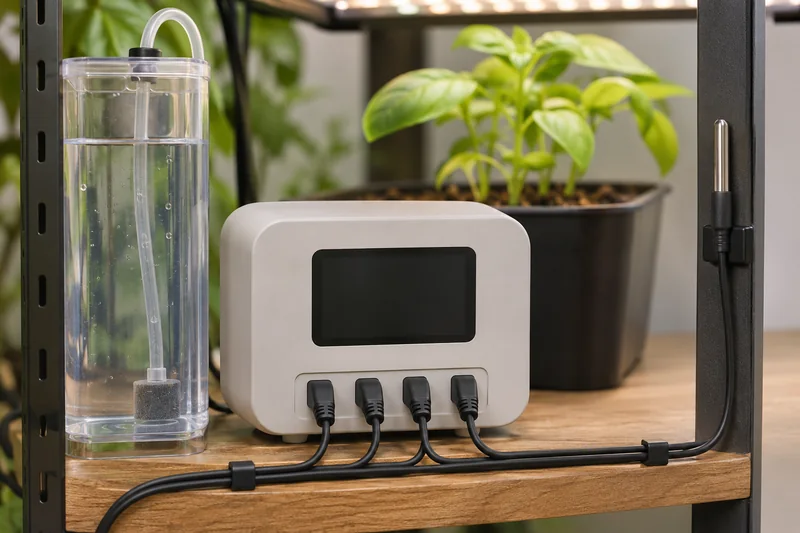
Growing automation connects measurements or schedules to defined actions. A reliable installation begins with the exact task, a supported electrical and communications path, and a known response to a lost sensor, network connection or power supply.
A sensor measures a condition. A controller evaluates a schedule, threshold or other rule. An actuator changes something physically, such as the speed of a fan, the flow of a pump or the state of a relay. One product can contain more than one role. For each planned function, draw the path from the measurement or timer to the rule and through the output interface to the load. A graph in an app is evidence of monitoring. A command routed to a supported load is evidence of an action path.
One feedback control path
Sensor reading
Controller rule
Actuator changes the measured condition
Open-loop versus closed-loop operation
Function
How the equipment acts
What to verify
Monitoring
Reports a reading or sends an alert for someone to act on.
Sensor scope, placement, alarms and whether the alert can reach a responder.
Open-loop scheduling
Switches or varies an output based on a schedule without measuring the resulting condition.
Time base, duty, manual override and the state after interruption.
Closed-loop control
Uses a measured condition to decide whether and how to change output.
Actuator authority, deadband, delay, sensor validity and safe fallback.
Timed watering can be automated and remain open loop. A humidity sensor may report humidity while a connected fan follows a timer independently. Closed-loop humidity control requires the measurement to influence the fan or a humidity actuator. Use a deadband or hysteresis where supported to reduce rapid switching near a threshold. A slow process can continue responding after the actuator stops, so delayed readings and excessive corrections deserve attention.
pH, EC and nutrient dosing
pH describes acidity and affects nutrient availability. An immersed probe may report continuously and still require cleaning, appropriate storage and calibration with the specified fresh buffers. Electrical conductivity, usually expressed in mS/cm for nutrient solution, reflects the aggregate conductivity of dissolved ions. It does not identify individual nutrients, nor does a single value reveal whether the solution is balanced. Match the meter’s unit and temperature-compensation basis before interpreting trends.
Dosing adds an actuator and a control problem. Compare the controller’s output to the exact dosing pump, tubing and solution restrictions. A controller that supports EC correction in one direction may need a different actuator to dilute or replenish water. A measured response should represent mixed solution. Delays between additions, dose limits and low-level interlocks can help contain errors from poor mixing, lost flow or a drifting probe. For multipart nutrients, follow the product’s handling and separation instructions and verify that each pump channel is assigned to the intended liquid. A dosing estimate is not proof of calibrated delivery or stable feedback.
Water pumps, timers and environmental sensors
A timer can irrigate at regular intervals, provided the pump, media and return are suitable for that duty. Check the motor’s allowed start frequency and the state after an interrupted cycle. Timed operation gives no indication that a clogged line delivered water. A reservoir level detector, flow switch or independent alarm can make a failure observable if supported and correctly placed.
Temperature and humidity probes describe a location. A derived value such as vapor pressure deficit (VPD) depends on the inputs and assumptions used by the controller. A measured air-temperature input and an assumed leaf temperature may explain a difference from another meter. Check whether the exact model uses the reading as a control trigger or only displays it. Place the probe away from direct spray or an unrepresentative intake stream and compare at canopy height when the reading governs canopy conditions.
Interfaces, protocols and electrical compatibility
A plug shape is a physical interface. A protocol defines how signals or messages are interpreted. Confirm the controller model and firmware, the actuator model, supported port and any exact adapter. Two sockets with the same shape may carry different voltages or signaling. A network connection between a phone and a controller says little about the electrical path to a pump or lamp.
For mains switching, compare regional voltage, frequency and plug type, plus the relay rating for the actual load class and startup current. A dimming connection has its own requirements, including documented signaling and whether the fixture can be turned fully off through it. If an outlet controller cuts power to a device, test whether the appliance resumes the intended mode when power returns. A device with a soft power button may remain idle. Use the specified electrical hardware and installation conditions, especially near water.
Offline operation, calibration and failures
Check three separate transitions: loss of internet with local power and networking present, loss of the local network, and restoration after a power interruption. On-device rules, clock retention, remote notifications and cloud schedules can behave differently. Look for a manual override reachable at the installation. Observe the recovery state of the controlled load as well as the controller.
Log probe service, compare readings after calibration and follow the maker’s storage instructions. Inspect dosing tubing, reservoir levels and relay behavior on a schedule appropriate to the equipment. Think through probe disconnection, an implausible reading, failed mixing and a stalled pump. Define which functions should pause when a prerequisite is missing and how someone will know they paused.
Practical automation scenarios
Timed watering for a shelf
Illustrative Scenario
A pump is supposed to run for 90 seconds four times per day. The timer only supports one-minute increments, so the required duty cannot be entered as written. Choose finer scheduling or re-evaluate the irrigation brief with the intended media. Verify flow and recovery after power loss. Time alone gives no evidence of delivery.
Monitoring before adding dosing
Illustrative Scenario
A household wants to log pH and EC across two independent 15 L tanks. A single probe set staying in one tank observes only that tank. Use manual checks in the other tank or dedicate a probe set to each. If automatic correction is added later, keep the feedback, mixing and dosing paths tied to the proper vessel. Matching tank volumes does not make the histories interchangeable.
A fan that must continue without internet
Illustrative Scenario
A resident needs humidity-triggered exhaust during a router upgrade. Check that the exact controller stores and executes the rule locally, that the fan is supported on the chosen interface, and that it returns to the required state after a power interruption. Use a separate local alarm if remote notifications are unavailable. This verifies a function path under specific failures, while the humidity target still depends on room air and exhaust capacity.
Common compatibility mistakes
Avoid choosing by connector appearance, number of ports or app screens alone. Count outputs by independently controlled endpoint. Verify the signal and electrical load path, confirm what happens when the network drops and establish how readings are checked before allowing them to trigger unattended actions.
Related products
Models listed here belong to this category in the GROWVELIA product database. Open a model for its full specifications, evidence and revision history.
Unknown2/10 applicable record fields documentedConflicting Data
Sensors and measured quantities
Not Provided
Controlled equipment
Not Provided
Physical interfaces
Type-C SGS device connection
Communications protocol
Conflicting Data
Power supply
Conflicting Data
Device ports
Conflicting Data
How to read product evidence
Coverage counts documented fields against applicable fields across the entire product record. Not Applicable fields are excluded. Not Provided fields lack a usable value. Conflicting Data is displayed with the disputed value withheld. Unknown market status remains Unknown until supported by a source.
Verify regional supply even when the controller-to-device relationship is confirmed.
FAQ
Can an EC monitor decide which nutrient to add?
Conductivity summarizes dissolved ions. The reading alone cannot identify which nutrient is depleted or establish a complete corrective action.
Does Bluetooth make a controller independent of the internet?
It describes one communications path. Test local rule execution, settings changes and alarms separately for the exact device.
Does a splitter provide independent fan settings?
A splitter may replicate a signal. Verify independent programming at the intended endpoints and the supported electrical load.
How do I tell whether a probe is drifting?
Check it against the specified fresh reference solutions and review stability after cleaning. Compare suspect readings before changing the reservoir.
Why might a relay switch but the appliance remain idle?
The appliance may require manual restart or reject a control mode after power cycling. Verify supported recovery and load ratings before depending on the relay.
Does a VPD value imply VPD-based control?
Verify that the model can use that value as a trigger and that a supported actuator is configured to act on it.
Sources and evidence
Technical mechanisms were checked against the references below. Illustrative scenarios use stated assumptions for planning calculations. Model details follow the catalog’s recorded sources and their revision scope.