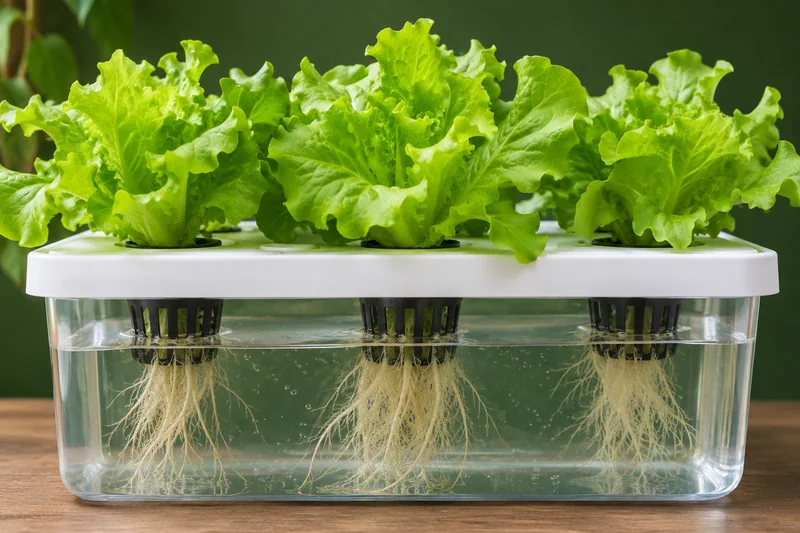
Hydroponic equipment supplies mineral nutrients through a water-based root environment. The practical choice is how the roots receive solution and oxygen, which components keep that delivery working, and whether you can reach those components when they need service.
Hydroponic designs can immerse the roots, pass shallow solution along a channel, or use water to wet a substrate that supports the plant. Aeroponics is a soilless technique in which roots hang in a chamber and receive atomized nutrient solution while exposed to air. A sprayer describes hardware, whereas aeroponics describes the root environment. A spray used to distribute water inside a tower or to irrigate media does not establish that the roots are grown aeroponically. Look for the root location, the documented delivery method and how the returning liquid is collected.
Supply and return in a recirculating system
Reservoir and intake
Pump and distribution
Root zone and return
DWC, RDWC, NFT, drip, ebb and flow, aeroponics and fogponics
Method
Root-zone delivery
Service or failure dependency
Deep water culture (DWC)
Roots extend into a nutrient bath, commonly served by an air pump and diffuser.
Air supply, solution temperature and access to the bath.
Recirculating DWC (RDWC)
Connected culture vessels share a bath circulated through a common loop.
Water-level balance, connections, return restrictions and aeration at the vessels.
Nutrient film technique (NFT)
A shallow moving stream reaches roots along a sloping channel.
Continuous delivery in normal operation, even distribution and a clear return.
Drip hydroponics
Emitters deliver solution to individual root zones, usually in media.
Emitter flow, wetting uniformity and drainage, whether recirculated or collected for disposal.
Ebb and flow
A tray fills intermittently and drains between floods.
Flood depth, drain timing, overflow provision and reservoir capacity after drain-back.
Nozzle-based aeroponics
Nozzles atomize nutrient solution into a chamber around suspended roots.
Spray coverage, pressure where specified, nozzle condition and interruption response.
Fogponics
A fine aerosol, commonly made with an ultrasonic transducer, carries solution droplets to air-suspended roots.
Fog generator condition, aerosol distribution, condensation and liquid level.
A top-feed DWC kit can drip into a basket while its established roots remain in a bath. That feed feature alone does not connect several baths into RDWC. Similarly, a channel with deep standing water from a restricted outlet no longer behaves like the intended shallow film. Identify the primary root environment before comparing hardware.
Fogponics is usually discussed as an aeroponic variant. Fog consists of liquid droplets suspended in air. It is distinct from water vapor, and an ordinary humidifier outside the root chamber is a different application. Some research systems produce fine aerosol with air-assisted nozzles. Product terms such as spray, mist and fog can overlap. A credible comparison needs the generation mechanism and the root-chamber arrangement. It should avoid claiming a universal droplet-size cutoff from those labels.
Root oxygenation and water delivery
Roots use oxygen in respiration. In a bath, oxygen has to reach the submerged root zone through dissolved gas. Temperature, biological demand and aeration all influence the available oxygen. Visible bubbles indicate air is being delivered at one point. They do not show that every vessel or portion of a root mat receives enough. In NFT, roots above the shallow stream have access to air in the channel. Media-based systems rely in part on the air space within the medium after drainage.
Trace the supply and return separately. A liquid circulation pump can feed a tray, yet a gravity return still needs enough capacity at its installed slope. Multiple branches can flow unevenly because the easiest path takes a disproportionate share. A growing root mat can change the route over time. Inspect the distribution end, accessible screens and any overflow path before judging a large pump as a cure for poor delivery.
Pump flow, head and reservoir capacity
Compare the manufacturer’s flow-versus-head curve for the exact pump and supply. The zero-head flow describes delivery at negligible total head. Maximum head occurs near zero delivery. At the installed operating point, the pump supplies the head the system needs at the same flow. Find that intersection using the system curve, which accounts for static lift where applicable and flow-dependent losses in pipe, fittings, emitters and filters. For a nozzle with a minimum working pressure, check the pressure at the nozzle and at the intended flow. Air pumps serve a separate oxygenation duty that needs its own evidence.
Separate total tank capacity from the amount available for circulation. During operation some liquid sits outside the reservoir. At shutdown the return may bring much of it back. Consider the minimum level needed to keep equipment operating, the maximum level after drain-back and a reserve for plant uptake and evaporation. Measure consumption with the intended crops. A kit's bucket size or reservoir name does not establish effective fill.
Clogging, maintenance and power interruptions
Media debris, mineral deposits, biofilm and roots can obstruct different parts of a water path. Select equipment whose nozzles, screens, lines and returns can be inspected without dismantling an occupied growing area. Follow the maker’s cleaning directions and verify flow after reassembly. Air delivery and liquid delivery deserve independent checks in systems that use both.
During a power failure, a bath may retain water while losing powered aeration. A shallow channel may drain, and air-suspended roots can lose their mist or spray. Remaining wetness depends on the media, chamber, temperature and plant load. No universal outage duration follows from the system name. Identify which components have to restart, what their restart state is, and how a failure would be noticed.
Home growing scenarios
Bucket greens with a shared air source
Illustrative Scenario
A grower adds a second 12 L working bath to a first bucket, assuming that a splitter provides equal aeration. Differences in stone resistance and immersion depth can change the distribution. Verify each vessel with its intended tubing and diffuser or keep separate air sources. Shared air supply leaves both vessels exposed to one pump failure, and observed bubbles alone do not quantify dissolved oxygen.
A drip shelf at two elevations
Illustrative Scenario
A lower tray needs 120 L/h and an upper branch needs 80 L/h in an illustrative equipment brief. Select from curve evidence at the installed head and assess branch flow separately. A rated 400 L/h at zero head supplies no evidence of 80 L/h at the upper branch. A layout with individually accessible branches may make verification easier. Emitter ratings and the drainage route still constrain the setup.
A flood tray above a small reservoir
Illustrative Scenario
A 15 L reservoir is filled to 12 L while a drained tray and lines later hold 4 L during operation. The reservoir drops to 8 L, before other losses. If 7 L is the pump’s operating minimum, the operating reserve is roughly 1 L. Adjust the usable volume or flood requirement and confirm the final drain-back level. This simplified balance assumes no trapped liquid and excludes crop demand.
Common technical mistakes
Selecting from the maximum-flow and maximum-head labels cannot establish a working operating point. Using a stronger pump can overload a gravity return. Adding a shared return to an existing bath changes the failure boundary for every connected vessel. These decisions deserve inspection of both the normal state and the unpowered state.
Related products
Models listed here belong to this category in the GROWVELIA product database. Open a model for its full specifications, evidence and revision history.
Coverage counts documented fields against applicable fields across the entire product record. Not Applicable fields are excluded. Not Provided fields lack a usable value. Conflicting Data is displayed with the disputed value withheld. Unknown market status remains Unknown until supported by a source.
See why total pump flow leaves branch distribution unresolved.
FAQ
Does every aeroponic system use high pressure?
Designs can use different atomization methods. Verify how the equipment creates droplets and what inlet pressure its particular nozzles require.
Is RDWC automatically better oxygenated?
The shared loop moves solution among vessels. Oxygen delivery still depends on the individual vessel design, aeration and root load.
Why is NFT sensitive to debris?
Narrow channels and outlets only have limited reserve when roots or debris obstruct the path. A blockage may deepen the upstream water while starving a downstream region.
Can one tank support different crops?
A shared tank gives them one common nutrient and operating regime. Separate tanks are useful when schedules or acceptable conditions differ.
Does adding a filter solve spray reliability?
A filter helps intercept particles appropriate to its rating. Deposits can still form and a loaded filter can reduce flow or pressure.
Can a fog generator replace any spray manifold?
Verify application-specific aerosol delivery through the chamber, liquid level requirements and service access. The change alters where and how droplets reach roots.
Sources and evidence
Technical mechanisms were checked against the references below. Illustrative scenarios use stated assumptions for planning calculations. Model details follow the catalog’s recorded sources and their revision scope.