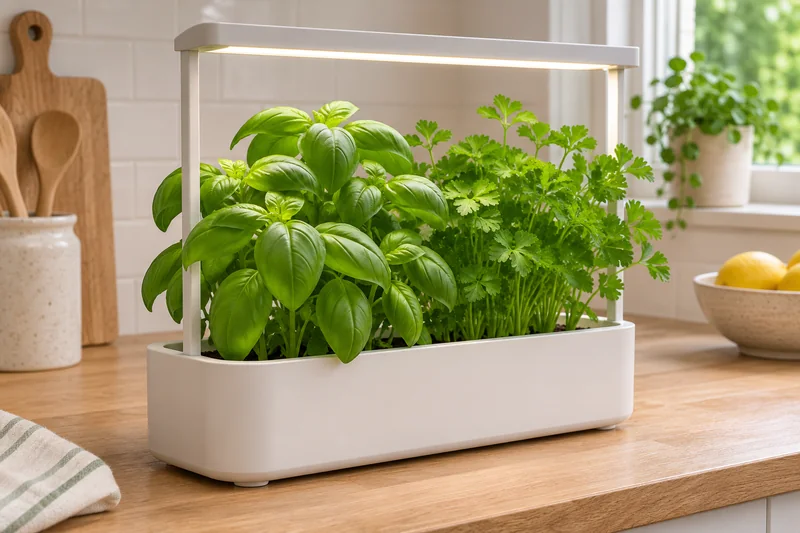
A countertop growing system puts a planting deck, water supply and overhead light within reach of the person who tends it. Compare how water actually reaches each plant, how much mature foliage the deck can carry, and whether the lamp and reservoir remain accessible in the intended counter space.
Most integrated units combine a shallow planting deck, individual cups or baskets, a reservoir, a lamp on a fixed or adjustable support, and a power supply. A common lid doubles as the planting surface and a shield against light entering the reservoir. Some systems add a float or level sensor, a liquid pump, an air pump or a controller. A cluster of pots under a separate light can serve a similar household role, but the integrated format determines which components can be moved, replaced or operated independently.
Seedlings start in a plug or substrate that has to stay moist while roots are short. As roots lengthen, they may keep drawing through the substrate or extend into a supplied channel or bath, depending on the system. Follow the documented path from tank to root and check whether the path after germination differs from the one used during establishment. That single distinction explains why fill marks, basket depth and the purpose of a pump matter.
Typical wick-fed countertop layout
Reservoir
Wick and plug
Roots in growing medium
Main system types
Root-zone design
How water reaches the plant
What to inspect
Passive wick watering
Capillary action carries water into a moist plug from the reservoir.
Wick-to-plug contact, media wetting and access to a replacement wick.
Active pump-based watering
A powered pump moves solution through a tray, channel, jet or feed line.
What the pump supplies, where water returns, and what remains wet during a stop.
Compact deep water culture (DWC), where documented
Roots extend into a nutrient bath with a provision for root oxygenation.
Bath depth, active aeration or other documented oxygen provision, and access below the deck.
A wick is a component with a service life. A dry plug above a full tank can point to a poorly seated wick or loss of contact. Passive delivery avoids a liquid-pump dependency, but the lamp still needs electricity and the medium must be suitable for continuous capillary supply. In a pumped model, a circulation feature can mix a reservoir without delivering solution to every starting plug. Inspect the layout before assuming that audible pump operation proves successful watering. A tabletop unit with submerged roots needs an oxygen strategy even when the motor runs on a cycle.
Growing positions, usable height and light
Count planting openings as starting positions. To estimate mature capacity, lay out the likely width of each maintained plant against the actual hole spacing. Check diagonal neighbors as well as adjacent ones and reserve an opening when two plants would compete for the same lit space. Harvest style matters. Cutting individual outer leaves keeps a plant in its position. Harvesting a whole head frees it for a new start.
Measure from the growing surface to the underside of the light at the setting you can actually use. Subtract the intended lamp-to-canopy gap and any rise from a basket or plug. External height includes the base and housing, so it rarely answers this question. With a shared lamp, an upright crop can force a higher setting for low-growing greens. Raising the light may spread the beam while reducing the light received at some positions. Check edges and corners at canopy height if the layout depends on them.
Reservoir, pods and maintenance
The nominal reservoir size, recommended refill amount, and usable drawdown above the operating minimum answer different questions. Allow access to the fill port with the lamp and plants in place. Check whether you can empty the tank at a sink or must remove water in the growing location. Roughly estimating an unattended interval requires a usable water reserve and an observed loss rate from the intended planting. A label capacity alone cannot establish either.
Pod compatibility involves holder geometry, media, a suitable wetting path and whatever the system expects for nutrients. A cup can fit the hole while the insert sits too high for the wick or young roots. Determine whether a ready-seeded refill, a blank insert or a separate nutrient purchase is required. Budget for the supplies you will actually replace, including failed starts and wicks or baskets if they are consumable in that design.
Plan to remove old roots, clear an intake or inspect an air stone where fitted, and clean accessible wetted surfaces between plantings as the maker directs. A removable lid helps only when you can lift it past the plants and lamp. A permanent counter location near a sink makes a short drain-and-refill routine more realistic than a larger tank that is awkward to reach.
Energy, ownership and model comparisons
A 20 W lamp running for 15 hours uses 0.30 kWh in that illustrative day. A separate pump, controls and standby draw add to the total according to their own operating hours. Multiply estimated energy by the local tariff, then add media, seeds, nutrients and replacement items over the same period. A smaller garden may be useful even when it rarely produces a full salad, particularly if the household wants a few frequently harvested herbs.
Start a shortlist with the intended crop, deck-to-lamp clearance, water path and supply model. The Smart Garden 3 and LPH-Mini records make different water-delivery approaches inspectable. The Smart Garden 9 and 9 PRO comparison focuses on added lighting control within one family. Treat any uncertain tank declaration as a question for the exact revision. A companion app helps only when its documented functions match the work you want to share.
Practical growing scenarios
A narrow kitchen ledge
Illustrative Scenario
Two cooks want basil and chives from a deck that provides three openings at 10 cm spacing. If the maintained foliage widths are 18 and 12 cm, their canopy radii total 15 cm. Adjacent holes under that simple footprint model offer too little separation. Use the two outside positions, cover the middle opening as directed and recheck after pruning. The same layout may fail if a large plant grows toward the lamp or a wall.
A garden below a hanging cupboard
Illustrative Scenario
A household has 49 cm of counter-to-cupboard clearance. Assume the deck sits 12 cm above the counter, the lamp housing takes 4 cm and the fixture must stay 10 cm above the canopy. Even before reserving space for an adjustment stroke or hand access, the calculated canopy allowance is 23 cm. Put the tall crop elsewhere or choose a compact harvest plan. Check the actual fixture and lid travel before committing to the location.
A weekend away with mixed greens
Illustrative Scenario
Suppose a running tank has 1.8 L available before its service minimum and prior checks show losses near 0.55 L/day with the current plants. Three days would consume about 1.65 L, leaving little margin. Arrange a refill or shorten the interval. This water calculation excludes pump faults, changes in room conditions and greater demand as the canopy grows.
Common selection mistakes
Buying by pod count can hide the smaller number of useful harvest positions. Counting the entire tank can overstate time between refills. Comparing initial purchase prices without replacement media can reverse the apparent cost advantage. A final check with the unit drawn in place should include the refill approach, deck removal, lamp travel and the width of a mature canopy.
Related products
Models listed here belong to this category in the GROWVELIA product database. Open a model for its full specifications, evidence and revision history.
Version unknown · Integrated countertop growing system
Unknown2/15 applicable record fields documentedConflicting Data
Nominal plant positions
8 sites
Effective growing height
Not Provided
Lighting power
Conflicting Data
Water tank capacity
Not Provided
Consumables
Not Provided
How to read product evidence
Coverage counts documented fields against applicable fields across the entire product record. Not Applicable fields are excluded. Not Provided fields lack a usable value. Conflicting Data is displayed with the disputed value withheld. Unknown market status remains Unknown until supported by a source.
Compare the light receiving planes of two plant heights below the same fixture.
FAQ
Can I run a garden with empty positions?
Often, if the manufacturer allows it. Cover unused openings as directed to limit light entering the wet interior and reserve the space for adjacent foliage.
Is a wick system hydroponic?
A wick can feed a soilless root zone. The useful distinction for shopping is how the documented substrate and nutrient supply work, including whether nutrients come from a prepared pod or the reservoir.
Why can a full tank leave a pod dry?
A level reading describes the tank. The plug can still sit above the wetted path. Inspect wick contact or pump delivery using the model’s service instructions.
Will a taller lamp grow taller plants?
It provides more geometric clearance. The receiving plane still needs suitable light, and the crop must fit sideways without shading adjacent plants.
Can I swap the lamp, pump or power supply?
Check the revision’s service parts and electrical specifications. A component that fits physically can have a different output, pinout or mounting requirement.
How should I compare refill schedules?
Use the usable drawdown and observations from a similar planting and room. Separate water loss from the system’s lowest permitted operating level.
Sources and evidence
Technical mechanisms were checked against the references below. Illustrative scenarios use stated assumptions for planning calculations. Model details follow the catalog’s recorded sources and their revision scope.