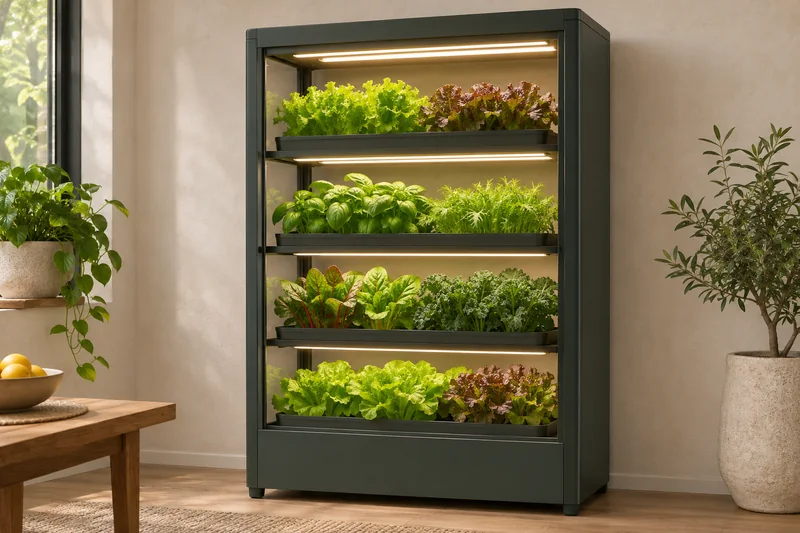
An indoor growing cabinet encloses a plant canopy, its lighting and some of its supporting equipment. The enclosure can contain light and organize the installation, but crop space, heat removal and climate control depend on what the cabinet actually contains and how it exchanges air with the room.
A cabinet groups plants and equipment inside a defined enclosure with a door or panel. The enclosure gives the installer surfaces for equipment, wiring and light management. It also creates a small volume in which lamps, fans, water and leaves influence one another. An open shelf shares room air freely and leaves more angles of access. A cabinet may reduce direct light spill and make access easier to manage, while concentrating heat and moisture unless those loads have an effective route out.
Exchange path in a ventilated cabinet
Room air intake
Cabinet and canopy
Cabinet exhaust to room
Enclosed versus open systems
Configuration
Useful capability
Limiting condition
Open shelf
Access from several directions and easy rearrangement.
Exposed light and equipment, with the growing zone closely coupled to the room.
Enclosure with circulation and fixed exchange
Directed airflow and light containment.
Indoor air and installed airflow determine much of the operating range.
Enclosure with feedback-controlled equipment
Sensors can trigger supported fans, heaters, humidifiers or other actuators.
Authority is limited by the fitted actuator, room conditions and control configuration.
Effective dimensions, shelf space and lighting
Work from cavity measurements at the shelf where the plants will sit. A power compartment, fan cover or duct can remove area from only one part of the rectangle. Measure door opening and hinge swing separately, since a tray that fits the interior can still fail to pass through the opening. Trace the path of a full reservoir to its refill and drain location. A sliding shelf needs adequate travel and a rated load appropriate to its contents.
For each tier, mark the shelf surface, container top, expected canopy and underside of the light. Account for fixture thickness and the selected gap once each. A lamp at the top of a cabinet cannot serve a lower tier effectively if an opaque shelf blocks it. Evaluate each fixture’s distribution with the corresponding tray and canopy in place. Reflective walls can change edge readings, so a map collected on an open bench may represent a different light field. Leave the clearances specified by the maker around fixtures, drivers and ventilation inlets.
Temperature and humidity monitoring versus active control
A sensor shows conditions at its sampling location. A display, trend graph or notification gives the user information. Automatic environmental control requires a rule that responds to a measurement and a connected actuator capable of changing the condition. A timed fan is scheduled operation. A humidity-triggered fan is feedback control of airflow, but the resulting humidity depends on incoming air and the cabinet’s moisture load. A temperature trigger for exhaust is not refrigeration.
A sensor next to a radiant fixture, wet leaf or air inlet may represent a local pocket. Place it where the reading corresponds to the occupied canopy and verify obvious gradients. Relative humidity changes with temperature even when the amount of water vapor stays the same. A warmer reading with lower relative humidity does not establish moisture removal. A controller’s menu range describes available settings. To judge achievable conditions, find the actuator, its capacity and the specified operating range.
Air circulation, exchange, ventilation and filtration
Circulation moves air within the cabinet and can reduce stagnant zones. Exchange takes air out and brings replacement air in. Exhausting into a closed room exports cabinet heat and moisture to the room. It does not remove them from the building. Identify the intake path as well as the exhaust and consider where outlet air goes. When the supply air is warm or humid, more exchange may have limited ability to lower cabinet temperature or water-vapor content.
If installed exhaust is known, divide volumetric flow per hour by the cabinet’s effective air volume to estimate nominal air changes per hour. It is a bulk indicator and does not describe air reaching the back of a crowded shelf. A free-air fan rating omits resistance from ducts, bends and filters. A filter can address the contaminants specified for that media, while adding resistance and requiring replacement. An odor filter does not substitute for a route that removes moisture and heat.
Noise, heat, energy and maintenance
Listen for the conditions represented in a noise declaration, including fan speed, distance and room. A stopped fan and an exhaust running at maximum speed are different operating states. Air turbulence, pump vibration and a cabinet panel can each contribute. Consider whether the loudest necessary mode overlaps with work or sleep. Most electrical input to an enclosed setup eventually appears as heat in the local indoor environment, even if some of it is initially emitted as light.
Build an energy profile from lamp wattage and schedule, continuously running circulation, intermittent pumping and variable climate loads. A device that draws 20 W all day uses 0.48 kWh. A 50 W lamp on for 12 hours uses 0.60 kWh. If room climate equipment is shared, distinguish its energy boundary from direct cabinet consumption. Plan for removal of filters, wiping condensate-prone surfaces, probe access and tray extraction without moving the enclosure.
Practical home scenarios
A two-shelf cabinet for seedlings
Illustrative Scenario
A shelf-to-shelf cavity measures 44 cm. A 10 cm tray, 4 cm fixture and a 15 cm light gap leave 15 cm for growth above the tray. Use the lower shelf for early starts and allocate additional height elsewhere for plants retained beyond transplant size. Check measured light on each tray and confirm the loaded tray clears the opening. The dimensions do not predict crop growth or verify shelf capacity.
Warm room, warmer cabinet
Illustrative Scenario
A household wants 24 °C inside while intake air reaches 27 °C in the afternoon. Exhaust alone exchanges toward room conditions under these assumptions, and lighting adds heat. Move the light period to cooler hours if the crop schedule permits, condition the room or choose suitable active cooling. Ventilation remains useful for other purposes. Required cooling capacity depends on the cabinet and room loads.
A study that shares the exhaust air
Illustrative Scenario
Suppose an enclosure has 0.60 m³ of usable air volume and 12 m³/h of installed exchange in a selected fan mode. The nominal rate is 20 air changes per hour. A large canopy can still obstruct the rear shelf and the study still receives the discharge. Check local air movement and room conditions independently. Moving the fan or adjusting tray arrangement may improve distribution, subject to the maker’s clearances.
Common selection mistakes
Do not plan from outer dimensions, a temperature display or a single fan rating. Decide how the room handles heat and moisture, which equipment acts on each condition, and how components are removed before buying an integrated unit. Compare revision-specific cabinet profiles for documented capabilities and evidence gaps.
Related products
Models listed here belong to this category in the GROWVELIA product database. Open a model for its full specifications, evidence and revision history.
Current per recorded source7/19 applicable record fields documentedConflicting Data
Usable internal space
Not Provided
Effective growing height
80 cm
Lighting configuration
Samsung 301D LEDs
Environmental monitoring
Not Provided
Active controls
Not Provided
Air exchange
Not Provided
Rated system power
Not Provided
How to read product evidence
Coverage counts documented fields against applicable fields across the entire product record. Not Applicable fields are excluded. Not Provided fields lack a usable value. Conflicting Data is displayed with the disputed value withheld. Unknown market status remains Unknown until supported by a source.
Evaluate daily energy when an on-state rating leaves actuator runtime unknown.
FAQ
Does closing the door increase usable crop space?
The enclosure creates a boundary for leaves, fixtures and air paths. Layout still depends on the cavity and on keeping access to the plant and equipment.
Can a fan lower temperature below the room?
Ordinary exchange with warmer intake air cannot maintain that cooling target by itself. Check the actual intake conditions or identify active cooling capacity.
Is a humidity alarm an automatic dehumidifier?
An alarm requests a response from someone or another system. Verify the hardware and control path that physically removes water.
What if air circulates but the walls remain wet?
Examine surface temperature, moisture sources and exchange. Mixing air can help distribution while the enclosure still has a condensation problem.
Can an extra shelf simply double production space?
Each tier needs adequate light, canopy clearance, airflow and access. The frame and shelf also need an appropriate loaded rating.
How do I compare noise claims?
Match mode, fan speed, distance and background conditions. Include the mode needed to manage heat or moisture during the hours that matter.
Sources and evidence
Technical mechanisms were checked against the references below. Illustrative scenarios use stated assumptions for planning calculations. Model details follow the catalog’s recorded sources and their revision scope.